A Familiar Situation
Agency leaders make hundreds of operational decisions every week. Most are thoughtful, necessary, and made in the best interest of clients, staff, and regulatory obligations. The challenge is not the quality of those decisions. It is that the reasoning behind them often disappears once the moment has passed.
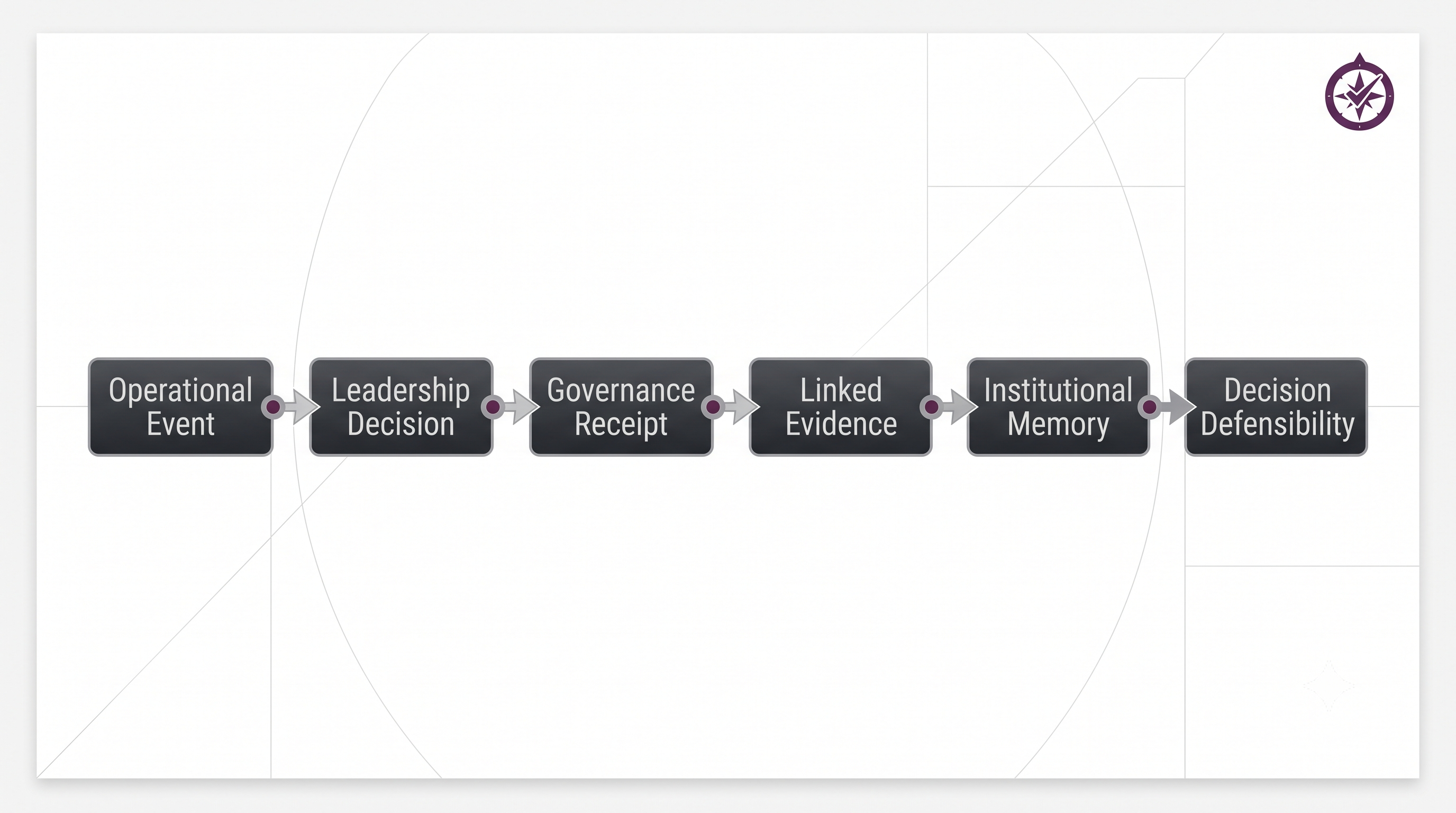
Governance Receipts provide a structured way to preserve decision history so leadership can explain not only what happened, but why it happened. They transform everyday operational judgment into durable organizational knowledge.
Imagine an auditor asks why a scheduling exception, documentation variance, or staffing decision was made eighteen months ago. The employee who approved it has moved on. The documentation shows what happened, but no one can confidently explain why. Most agencies have experienced some version of this moment. It is not a failure of commitment. It is the natural consequence of relying on conversations instead of institutional memory.
The Missing Piece
Traditional documentation captures activity. Governance Receipts capture leadership reasoning. Together they create evidence that survives staff turnover, leadership transitions, and the passage of time. Rather than asking agencies to document more, the objective is to preserve the context behind important operational decisions.
The PARE Perspective
PARE views Governance Receipts as a practical way to preserve the reasoning behind important operational decisions. Rather than allowing context to disappear into conversations, emails, or memory, Governance Receipts help organizations retain the decision history that gives operational activity meaning.
The result is stronger organizational continuity, greater leadership confidence, and a more complete understanding of why important decisions were made.
Practical Implications
Leadership turnover, regulatory change, payer reviews, employee relations, and operational exceptions all become easier to navigate when important decisions have a preserved rationale. Instead of reconstructing history under pressure, agencies can demonstrate thoughtful governance through contemporaneous evidence.
Continue the Conversation
Publication 1 introduced the governance gap. Publication 2 demonstrated why preserving decision history matters. Publication 3 explores what becomes possible when governance evidence becomes executive intelligence.
If your agency is ready to move beyond reactive compliance and begin building a governance framework that preserves institutional knowledge and strengthens decision defensibility, we invite you to schedule a conversation with PARE.
Every engagement begins with understanding your agency, your operational environment, and your governance objectives.
PARE Reflection
Governance is not built in a day or with one decision. Every well-governed agency leaves evidence of how it thinks.